

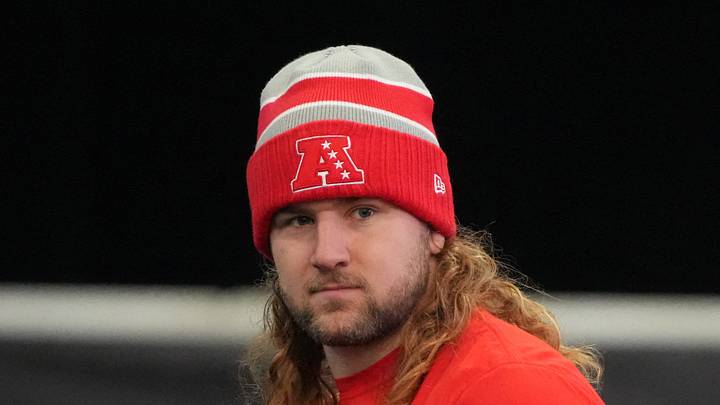
In the first ten games of his NFL career, Indianapolis Colts tight end Tyler Warren averaged almost 12.5 yards per reception. For a high-volume tight end, that’s very good. It’s in George Kittle/Brock Bowers territory. Pro Bowl territory.
In the 13 games he has played since, Warren’s yards-per-reception has taken a nosedive. In that span, he has averaged 7.18 yards. That’s mundane. Slightly below average.
The Colts offense has sputtered through the first half of 2026 due to Daniel Jones’ regression and Alec Pierce’s injury. Jonathan Taylor has not been as productive as normal.
Indianapolis Colts desperately need the Tyler Warren they saw in the first part of 2025
But the falloff in Warren’s play is more mysterious – and potentially more detrimental – than anything else that has gone wrong this season. And Shane Steichen, or whoever succeeds him, had better figure out what the problem is, or this could have major long-term implications.
Jones will either improve, or he’ll be gone. Pierce presumably will recover at some point. Taylor may well be traded. If he isn’t, he’ll be just fine, provided the rest of the offense recovers.
But Warren is different. For one thing, he is a major part of that expected offensive recovery. For another, he is a recent first-round draft pick. He’s not going anywhere. He will be the Colts' starting tight end for at least the next two seasons, and hopefully many more to come.
Apart from Anthony Richardson, Warren is the highest draft pick the team has added since Quenton Nelson in 2018. Richardson has already flamed out. A team can withstand one missed first-rounder, but it is very hard to build a winner if multiple top picks don’t develop into stars.
This is especially true with a team like the Colts, who did not have first-rounders in 2019, 2020, and 2022. The margin for error grows smaller when you don’t have as many premium picks.
Of course, it’s far too early to call Warren a bust. But there is no denying he has been struggling, along with the rest of the club, this season. The numbers almost defy belief.
In his first ten games, Warren had just one game in which he did not average more than 10 yards per catch. Since then, he has had just one game in which he did reach that number. (Week 5 against the Steelers this year).
His current yards-per-catch figure is 6.8, among the lowest of all starting tight ends in the league. It would be convenient if we could attribute this lack of production to Pierce’s absence. I do think the lack of any kind of vertical threat has hindered the entire passing game in 2026.
But this fall-off actually began after the Colts returned from their bye in the second half of last season. Something happened to the offense that has nothing to do with Pierce’s unavailability.
This season, that falloff has continued.
If we dig a little deeper into the numbers, we can find some inexplicable developments. Warren’s average depth of target this year is a mind-bogglingly low 4.3. For a young athletic tight end with good speed and route-running skill, that makes no sense.
Indeed, amongst all starting tight ends, it is the second-lowest figure in the league. The average depth-of-target for a starting tight end settles in right around seven yards. Some, like Bowers and Dalton Kincaid, are over ten.
The only tight end with a lower ADOT is Seattle’s AJ Barner. There are two things that distinguish Barner from Warren.
First, Barner only accounts for about 13% of Seattle’s target share, while Warren gets closer to 20% of the Indy’s throws. So Barner just doesn’t figure into his team’s passing attack as much as Warren does.
The other data point is more telling. Barner, despite his very low ADOT, has a healthy 8.0 yards after the catch per reception. So, he is running shorter patterns but gaining good yardage after the catch.
Warren, on the other hand, is picking up 4.5 yards after each catch. Barely half of what Barner gets. So you have a player – supposedly a star player – running very short patterns and then getting very little after he makes the catch. That is not a recipe for success.
Warren’s ADOT is down from last year. His YAC per catch is down from last year. Consequently, his yards per catch have dropped from 10.8 as a rookie to 6.8 through the first half of his second season.
Jones' quarterback rating when targeting Warren has dropped from right around 100 last year (a top-ten rating) to right around 80 this year (a bottom-ten rating).
Colts fans are simply left scratching their heads. Why can’t Tyler Warren run deeper patterns? Everything about his athletic profile suggests he should be able to. Is this a design problem? Are Steichen and Alex Tanney simply failing to design plays to take advantage of Warren’s skills?
Or are we simply seeing the limits of what Tyler Warren can do? The Colts need to answer this question ASAP. Which is the real Tyler Warren? The ascendent rookie we saw at the beginning of 2025? Or the very mediocre performer we have seen in his last 13 games?
 Add us as a preferred source on Google