

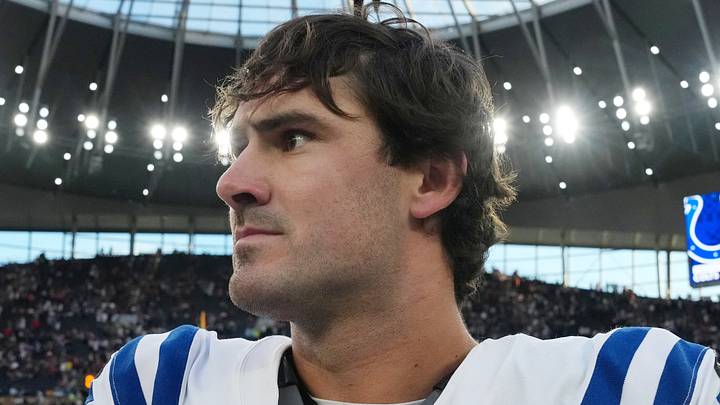
The Indianapolis Colts failed to build on the sliver of momentum they had finally established a few games into the 2026 season. Shane Steichen’s crew snapped their nine-game losing streak in Week 3 against Houston and then played a solid game against the Washington Commanders in a Week 4 win.
That all came crashing down in Pittsburgh on Sunday. The 34-22 loss wasn’t the biggest disappointment. What was far more troubling was the way Indy lost. Recurring problems that seemed headed in the right direction were splashed across this latest defeat.
A team that had talked about playing with urgency reverted to the same old mistakes that have plagued it dating back to the second half of 2025.
3 takeaways from the Indianapolis Colts' Week 5 loss to Pittsburgh
On one hand, the diagnosis of this team’s problem is very simple. The defense is not good. And the offense, which covered up defensive failings for much of last year, is not nearly good enough to do the same this year. Fixing those problems is much harder because, as we have noted repeatedly, this team simply is not constructed to be resilient.
The defense simply doesn’t have enough talent
When I say that the squad isn’t built to be resilient, I do not mean that the players are not tough and hard-working. I think they played hard on Sunday. They did not give up by any means. I just mean they do not have the depth of talent to compete with most teams in the league, especially on defense.
Realistically, how many Colts defensive players would start on an upper-tier NFL club? I count three. DeForest Buckner, Sauce Gardner, and Laiatu Latu. There are a few other good players – like Cam Bynum and Grover Stewart – but those three are the only players who are well above average.
On the other end of the spectrum, they have glaring holes. The club does not have a single upper-level linebacker. They have zero depth on the edge after Latu. The secondary, even with Gardner, is suspect. Those holes make this defense very easy to attack.
That is how Pittsburgh, which entered the game ranked in the bottom half of the league in almost every meaningful offensive category, managed to put up 34 points (compared with their 19.3 average) and gain 6.5 yards per play (compared with their 5.0 figure coming in).
Chris Ballard has not acquired good enough players on defense. It was a noticeable problem last season that has not been addressed this year. The results have been woefully predictable.
There is virtually no vertical offense
Steichen took deep shots. Mostly late, when the game was on the verge of slipping away. Those shots were rarely effective. However, he did throw deep several times on the third drive. Even though only one of the three deep balls was completed, the mere fact that he tried to stretch the defense helped Indy score its first touchdown.
This is partly a talent issue. Without Alec Pierce, Indy has no reliable deep threat. It is partly a design issue. Creative play callers find ways to manufacture opportunities downfield, even if they don’t have the best talent. Steichen and pass game coordinator Alex Tanney have not been able to do that.
And it is also a Daniel Jones problem. Jones is simply not playing anywhere near his level from last season. I think he is still either physically or psychologically (or both) diminished as a result of his injury recovery.
But whatever the reason, he is not throwing the ball deep with any accuracy. He is not running, which might put extra pressure on the defense and free up passing lanes. Any final verdict on Jones should probably wait on Pierce’s return to action. But for the team as a whole, they simply aren’t a very potent offense, in part because they have virtually no vertical attack.
The red zone continues to be a problem
Spencer Shrader kicked five field goals. He continues his excellent start to the 2026 season. But you don’t win many games when your kicker has five field goals, especially when you have a subpar defense that is not going to shut down opposing offenses.
The fact that two of those kicks came from inside 30 yards gives some indication of just how much the Colts' red zone offense continues to struggle. Those two kicks came in the second half. Had they converted either red zone trip into a touchdown, they would have taken the lead in the game.
On the first series, they had the ball first-and-goal on the three. Two Jonathan Taylor runs yielded a loss of one yard. Then an incomplete pass led to the field goal.
The second series began with a first-and-goal from the 10. Three straight incompletions led to another short field goal. The biggest takeaway here is just how predictable the play-calling was. When they were close, they ran against a stacked line and failed to move. Then they threw on third down, as the Steelers probably figured they would.
On the second series, when they were farther away from the end zone, they threw on every down. This strategy recalls several earlier series (one coming in the first half of this game) where Steichen has steadfastly adhered to predictable calls. The problem is it hasn’t been working. So maybe it is time to go against the book. Add a touch of counter-intuition to the mix.
In other words, throw the ball on first-and-goal from the three. Maybe save the JT dive for first-and-goal from the ten, when the defense is expecting a throw.
Just a thought. The Colts' defense may get incrementally better with repetition, but it is not going to suddenly become elite. So this offense had better grow more dynamic pretty fast.
 Add us as a preferred source on Google