

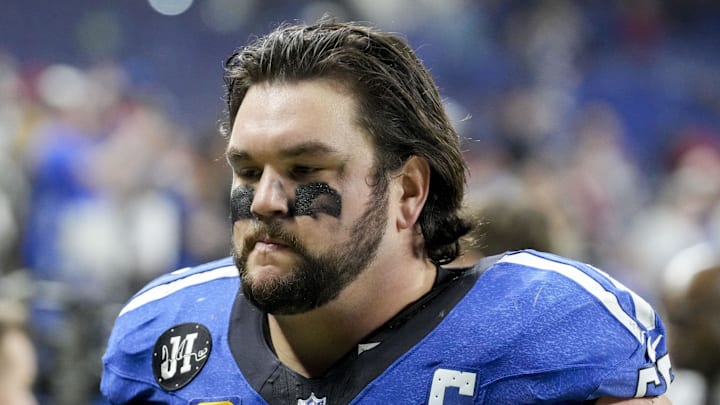
The NFL guard market is booming. Zion Johnson just signed with the Browns for $16.5 million per year despite being average at best. So, while the Colts are getting a discount by paying star left guard Quenton Nelson just $18 million this year, the team should be thinking ahead. Especially when you consider what he means to Indianapolis' offense.
Nelson will be a free agent next year. He will also be 31 years old. There's a thin line to tow here for Indianapolis. But they should be pursuing an extension with their star blocker and try to avoid him hitting the open market next year, where desperate teams will overpay for talent.
But how much and how long?
Projecting a Quenton Nelson extension with the Indianapolis Colts
Over the past three seasons, Nelson has played all 51 games, allowing just 56 pressures and a pressure rate of 2.90%, a pressure rate of 4.64% on true pass sets, and a weighted Pro Football Focus run block grade of 79.9.
Since 2024, those metrics go to 34 games, 35 pressures, 2.81% pressure rate, 4.89% pressure rate on true pass sets, and a weighted run block grade of 83.3. And last year Nelson was still at it at age 29, playing in 17 games, allowing just 15 pressures, a 2.35% pressure rate, 4.69% pressure arte on true pass sets and an 84.3 run block grade.
Looking at comparable players using Pro Football Focus' (subscription required) data who have signed contracts since 2020 here are his best comps for each time horizon.
Player | Age | Snaps | Pressure Rate Allowed | TPS Pressure Rate Allowed | Weighted PFF Run Block Grade |
|---|---|---|---|---|---|
Quenton Nelson (2023 - 2025) | 30.5 | 3,263 | 2.90% | 4.64% | 79.9 |
Joe Thuney (2018 - 2020) | 28.8 | 3,240 | 3.06% | 4.81% | 68.4 |
Player | Age | Snaps | Pressure Rate Allowed | TPS Pressure Rate Allowed | Weighted PFF Run Block Grade |
|---|---|---|---|---|---|
Quenton Nelson (2024 - 2025) | 30.5 | 2,122 | 2.81% | 4.89% | 83.3 |
Joel Bitonio (2018 - 2020) | 29.9 | 3,100 | 2.75% | 4.79% | 74.5 |
Player | Age | Snaps | Pressure Rate Allowed | TPS Pressure Rate Allowed | Weighted PFF Run Block Grade |
|---|---|---|---|---|---|
Quenton Nelson (2025) | 30.5 | 1,039 | 2.35% | 4.69% | 84.3 |
Joel Bitonio (2020) | 29.9 | 1,061 | 2.92% | 5.08% | 80.9 |
Except for age, Nelson compares favorably to each comp. Thuney and Bitonio both signed their deals in 2021 when the salary cap made a COVID-19-driven dip from $198.2 million in 2020 to $182.5 million. I adjust this by placing that year's salary cap at the midpoint of 2020 and 2022, which comes to $203.2 million.
Using that salary cap maker, both Thuney and Bitonio signed for APY's equal to 7.87% of the cap. A commiserate APY in 2026 is $23.67 - $23.75 million. Nelson should use these two as comps and fight for a similar deal. Especially because he has performed better than Brandon Scherff did in the lead-up to his 2022 deal with the Jaguars, with a $16.5 million APY that was 7.93% of the cap.
On the surface, that would make Nelson the second-highest paid guard on an APY basis - just behind Tyler Smith of the Cowboys. But the effective APY of this deal, which folds the existing years and money on Nelson's current deal, will come in at less than that.
A three-year, $71 million extension would create a total deal of four years and $89 million, with an APY of $22.25 million. If the Colts were to even the cash flows over the four years, it would give Nelson a $4.25 million raise this year, moving him from ninth to second in cash earnings.
$44.5 million in guarantees would be an increase of $42.5 million from his current guarantees. This structure would basically guarantee his 2026 and 2027 salaries and let the Colts go year-to-year in 2028 and 2029.
The team doesn't need a significant amount of cap space, so they can lean heavier on base salary and lighter on a prorated bonus. But the bottom line is that structure won't prohibit the team from moving on in 2027 due to salary cap reasons.
This is a win-win for both sides. Nelson gets a near-market setting deal and security beyond this year. The Colts get to lock in to one of their best players for the foreseeable future without committing too much to his 30's. And they get to avoid the craziness that is open market free agency.
 Add us as a preferred source on Google