

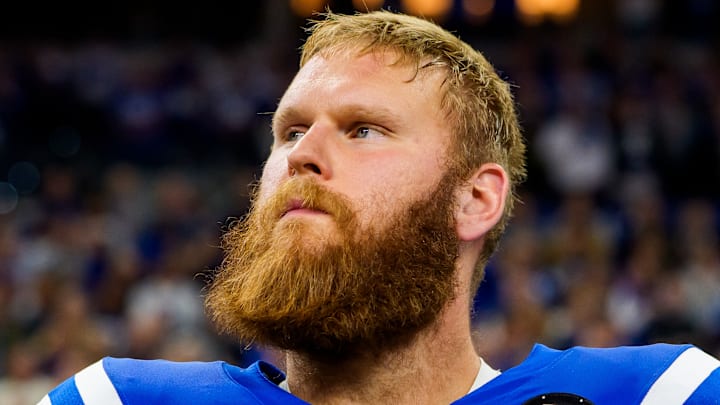
Indianapolis Colts tackle Braden Smith notoriously missed a large portion of last season, ultimately ending on injured reserve, and at the time, no one knew why. This April, Smith opened up about why: he had experienced a mental health crisis. Smith finally opened up about why in April.
Smith, it turned out, had been diagnosed with obsessive-compulsive disorder (OCD) that, in his case, presented as severe religious scrupulosity. It became so serious that Smith was near suicidal, and his wife would refuse to allow him to be around their children alone.
Conversely, the Colts suffered a huge loss when longtime owner Jim Irsay died unexpectedly in May. His Kicking the Stigma initiative won the Colts the Sports Humanitarian Team of the Year award at the ESPYs, the first ever to do so based on mental health. Considering Irsay's passion for mental health advocacy, he would likely highly approve of the award the Colts just gave Braden Smith.
This Indianapolis Colts honor goes deeper than football
Each year, all 32 teams choose one player to be the Ed Block Courage Award recipient, and this year, they chose Braden Smith — specifically for his battle with mental health, his openness about the experience, and being able to come back to the team again after it all.
"Obviously, he went through some things – as we all know – last year," head coach Shane Steichen said in the press release. "But to be able to bounce back from that, and the support that his teammates gave him – I'm sure he's got great support at home with his wife and his kid. Just the mental toughness, and he's in a really good spot right now and he's playing at a high level."
Mental health, thanks to Irsay, is a huge passion for the Colts. The team's Kicking the Stigma initiative aims to raise awareness about mental health and expand access to treatment centers; additionally, as the name states, the program looks to eliminate the negative stigma surrounding mental illness.
It took tremendous courage for Smith to publicly speak about what he went through last year. He eventually had to spend time in an intensive inpatient mental health facility in Colorado, underwent a five-day ibogaine treatment to "reset" his brain, and focused on therapy. Eventually, it worked, but not before he reached some deep lows.
“I was physically present, but I was nowhere to be found,” he said earlier this year. “I did not care about playing football. I didn’t care about hanging out with my family, with my wife, with my newborn son. … I (felt like) was a month away from putting a bullet through my brain.”
Since the experience, Smith has been a vocal mental health advocate. This year, for the Colts' 2025 "My Cause, My Cleats" game, he represented the International OCD Foundation. He has been a huge asset to this Colts team, and there is no better example of courage than Smith.
 Add us as a preferred source on Google