

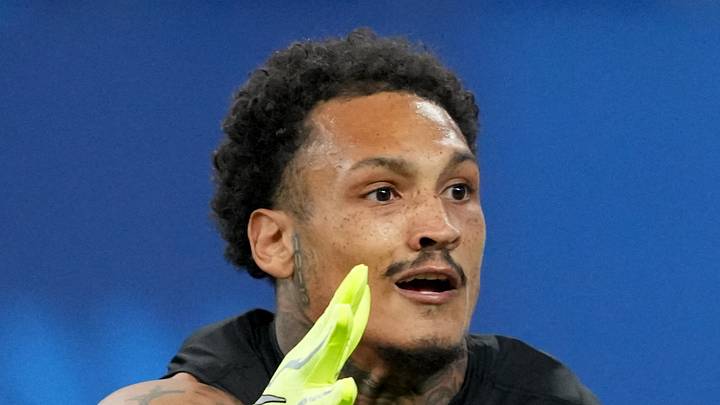
Indianapolis Colts general manager Chris Ballard chose eight new players in the 2026 NFL Draft. All eight passed their first test and made the final 53-man roster. That may not be terribly surprising given the number of veterans Ballard allowed to leave this offseason through free agency or trade.
And since he spent most of his own free agency money on re-upping players like Daniel Jones and Alec Pierce, there wasn’t much left to bring in upper-level veterans. The bottom line is that those eight rookie draft picks will be expected to contribute in a significant way in 2026.
How likely is it? It’s impossible to really know right now, but as we have come to see in the Chris Ballard universe, everything is kind of flipped on its head.
What impact will the Indianapolis Colts’ 2026 draft class have this year?
There’s a very good chance that for much of 2026, the last four players Ballard chose – all coming after the 150th pick in the draft – will have a bigger impact than the first four, all of whom came in the top 150. Fans of Stranger Things may be put in mind of the Upside Down, but there’s a decent chance this could all work out rather nicely for the Colts.
Then again…
Let’s start at the back of the line. The two players Ballard took in round 7 – Deion Burks and Seth McGowan – could end up playing quite a bit this year. Burks begins as the fourth or fifth wide receiver on an iffy unit. Alec Pierce is returning from injury.
Keenan Allen just arrived. His fellow backups, Ashton Dulin and Laquon Treadwell, have not logged many snaps at receiver for quite some time. Burks beat out Anthony Gould and Coleman Owen for a spot as a receiver and likely kick returner.
McGowan may not log a lot of snaps, but he could end up as the most valuable rookie on this year’s squad. If he can take 200-300 snaps in the backfield, that’s extra rest for Jonathan Taylor, which theoretically will keep the star runner fresh throughout the season.
And if JT should miss time with an injury, McGowan is his logical replacement, which would raise both his profile and his snap count much higher.
The other two back-half draft picks play the edge. George Gumbs and Caden Curry were both seen as promising developmental players when Ballard chose them in the fifth and sixth rounds, respectively. However, after Laiatu Latu, the Colts’ edge rusher situation is anyone’s guess.
Veteran Arden Key should get a lot of work opposite Latu. Veterans Jaylahn Tuimoloau and Michael Clemons are currently listed ahead of the rookies on the depth chart, but don’t be surprised if that changes.
Tuimoloau and Clemons have yet to prove they can consistently provide quality pass pressure. Curry looked very active in the preseason and could work his way into what is expected to be a four-man edge rotation before too long.
The top half of the draft has more questions. Fourth-round offensive lineman Jalen Farmer should not play a lot as a rookie. That has more to do with the quality of the players ahead of him than his own shortcomings. Teams do not rotate offensive linemen. If the Colts’ starters remain healthy, Farmer should see action on special teams only while adjusting to the NFL.
But if there are injuries, the rookie could be called upon sooner. And given the current depth chart, any injury to a guard or tackle might open a spot for him. Starting guard Matt Goncalves is the team's swing tackle right now. If anyone other than center Tanor Bortolini has to miss time, Farmer will be competing with young vet Dalton Tucker for a fill-in role.
The other three early draft picks are expected to be important parts of the Colts' rebuilt defense. 2025 starters Zaire Franklin, Germaine Pratt, and Nick Cross are gone. In an ideal world, their positions would be filled by rookies CJ Allen, Bryce Boettcher, and AJ Haulcy.
However, as the season begins, none of those rookies may be starters. Haulcy has been dealing with an injury, and he may begin the year backing up Hunter Wohler. Regardless of who starts, both Haulcy and Wohler should see a lot of action at safety this season.
The linebackers are harder to predict. Boettcher has looked very active in the preseason. But he has also run himself out of plays too often. He needs time to grow into a bigger role. He will no doubt be on the field for defensive snaps, but he may give up time to more experienced players at the beginning of the season.
Second-round pick CJ Allen is expected to be the lynchpin. 2026 marks the fourth time in the last eight seasons that Chris Ballard did not have a first-round pick. He has had a mixed history in trading out of the first round.
Allen was initially seen as a steal – a player who could step right into Zaire Franklin’s role in the middle of a revamped defensive unit. Those expectations have been severely curtailed after a preseason marked by injury and indecisiveness.
CJ Allen is going to play – probably a lot – this year. We will see fairly soon whether his slow start is largely attributable to those early injuries or whether he was overvalued by Ballard.
By the end of the season, it is likely that Allen’s snap counts will be in the same ballpark as those of Boettcher and veterans Austin Ajiake, Jaylon Carlies, and Akeem Gaither-Davis.
Based on what we have seen thus far, I wouldn’t be surprised if Gaither-Davis and Carlies end up with the most snaps in 2026. But when we reach the second half of the year, Allen’s snap counts need to be on the rise. If they are not, that is a very bad sign for the rookie.
But as any fan of the Upside Down knows, every ending has a beginning.
 Add us as a preferred source on Google