

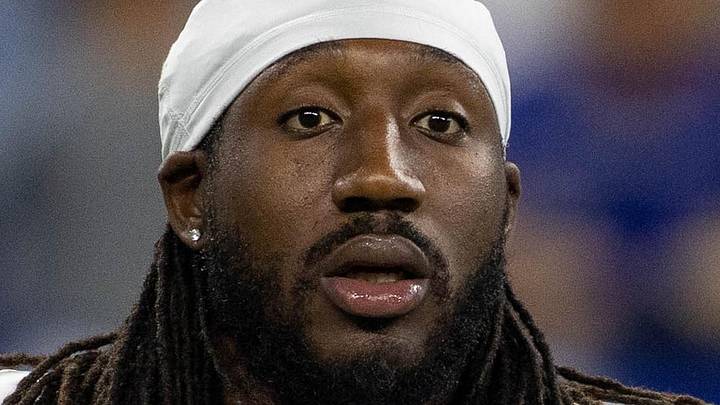
Veteran Colts tight end Mo Alie-Cox got a nice mention recently. Pro Football Focus (subscription required) wrote an article identifying NFL players who had increased their season grade for three consecutive years. Alie-Cox showed up in the final category, “Rejuvenated Veterans,” along with Jake Brendel, Taylor Moton, and Hunter Henry.
These aren’t exactly the biggest names in the league. The brief description of Alie-Cox noted that four years ago, he was among the lowest-rated tight ends in the NFL, but he has steadily improved in recent seasons. Backhanded compliment, perhaps, and one that also fails to take into account the general improvement in the Colts’ offense over that period.
In 2022, Indianapolis had a bottom-quarter offense. In ’23, it was in the low middle. In ’24, the high middle. And last year, top ten. Did Alie-Cox get better, or did he simply follow along with the trending offensive improvement? Hard to tease that out. But it’s still a compliment, right?
Indianapolis Colts veteran Mo Alie-Cox could benefit from the new league trend
Here’s what is not hard to tease out. Mo Alie-Cox is 32 and has not been a significant pass catcher for the Colts since 2021. In recent years, he has evolved into a very traditional in-line blocker who gets on the field for about 40% of Indy’s offensive snaps. Given his age, some writers (OK – it was me) have suggested he might be at the end of his career.
Now, it appears he might be in for a bit of a resurgence. It is largely because of the latest hot topic in NFL offenses – 13 personnel.
You know 13-personnel is a big deal because the Rams’ Sean McVay is its biggest proponent. McVay is a genius, so if he likes it, it must be hot.
The concept isn’t hard to grasp. 13 personnel divvies up its five eligible pass catchers (not counting the quarterback) like this: one running back, one wide receiver, and three tight ends. McVay used it to great effect with the Rams last year.
Other teams have been employing the offense as well, though not with the same efficiency as LA. When the Chicago Bears used a third-round pick this year to take the mammoth tight end Sam Roush, it was immediately assumed that fellow offensive genius Ben Johnson would be following McVay down the 13 path.
The Bears already had two high-value tight ends in Coleston Loveland and Cole Kmet.
Long story short – offensive-minded coaches have long experimented with how to employ tight ends because they offer great flexibility. Joe Gibbs did it with his H-backs in the 1980s.
Bill Belichick (who may have been considered a defensive-minded coach but was equally innovative with offense and special teams) put up more than 30 points per game in 2011 with Rob Gronkowski and Adrian Hernandez.
McVay’s 13 personnel shift is a logical evolution. As the NFL has encouraged more passing, defenses have gotten smaller and quicker. Most teams no longer employ a front seven as a base defense. Now it is a front six with five defensive backs.
While virtually every position on the football field has gotten bigger over the past fifty years, interior linebackers are virtually the same size as they were in the 1970s. Many are under 230 pounds.
So offenses can counter that by putting more tight ends on the field. They can still throw, but they can overpower that undersized back seven as well. Mo Alie-Cox is 6’5”, 267 pounds. Drew Ogletree, the Colts’ third tight end, weighs in at 260. Tyler Warren – 6’6”, 256.
The Colts also have three other tight ends on the roster. One is the 6’8”, 250-pound basketball convert Carson Towt. He is considered a development project at this point, but Shane Steichen has to be intrigued by that size.
Of course, none of this means anything if the players can’t play. That’s why Alie-Cox’s increased PFF grades over the past three seasons are encouraging. He still appears to be a capable player, as does Ogletree.
With no obvious top-level successor to the departed Michael Pittman, Jr, and with Alec Pierce’s early-season availability in question, 13 personnel could be the ideal offensive scheme, which can best utilize Jonathan Taylor’s running, while still offering pass-catching options.
Far from being an age or salary-related casualty, Mo Alie-Cox might just be in line for his most productive season as both a pass catcher and a blocker since 2021.
 Add us as a preferred source on Google