

When Marvin Harrison became the Indianapolis Colts' all-time leader in receptions in 2002, he surpassed a franchise record that had stood for 35 years. That same year, he established a new Colts standard for receiving touchdowns, also breaking a 35-year-old mark.
It would take him until 2003 to become the Colts all-time leader in receiving yards. That previous record had been on the books for 36 years. The man whose records Harrison broke was Raymond Berry.
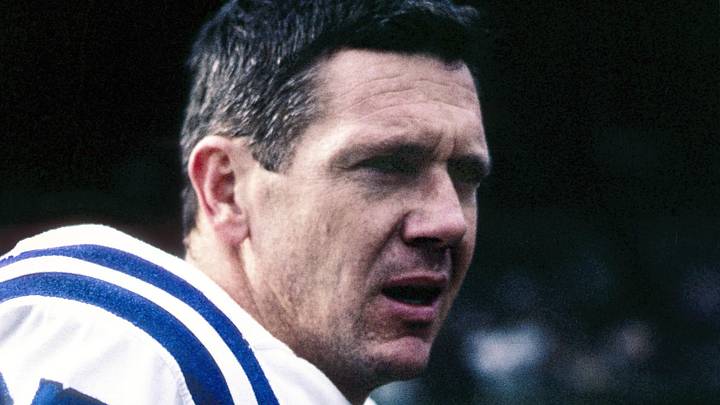
Berry, a five-time All-Pro and six-time Pro Bowler back when the Colts played in Baltimore, died last week at the age of 93. He played his entire 13-year career in Baltimore before going on to a long coaching career that peaked with a six-year run as head coach with the Patriots.
Raymond Berry, the Colts legend who went from obscure collegian to the Hall of Fame
Actually, Berry held all the major franchise receiving records for a lot longer than those 35 or 36 years. The Colts played their first season in 1953. Berry entered the league two years later. Consequently, the franchise had no receiving legends for him to track down and surpass.
Early on, his main competition for a place in the team record books came from his fellow end Jim Mutscheller. By 1960, Berry had put Mutscheller and everyone else in his rear-view.
Berry was drafted in 1954 and made his debut in 1955. He was not exactly a blue-chipper. The draft back then ran 30 rounds, and the SMU product was chosen in the 20th. Only one other player from that round lasted more than one season in the NFL. Berry played for 13 years, retiring in 1967.
His rookie season was nothing special. Then the Colts brought in a young quarterback named Johnny Unitas, and two Hall of Fame careers were launched.
In his first season playing with Unitas, Berry caught 37 passes for 601 yards. The following year, he raised those totals to 47 and 800 yards. He also scored six touchdowns. (This is back when the NFL season ran just 12 games.)
That third season was also his first All-Pro year. He was a second-team choice. He would be a first-teamer for the next three years. In 1960, Berry led the league in receiving yards – the third time he achieved that feat. The 1,298 yards he gained through the air were the second most in league history at the time, trailing only Elroy Hirsch’s 1951 season.
His greatest moment may have come in the famous 1958 NFL championship game. (The Super Bowl was still more than five years away.) Berry caught 12 balls for 178 yards and one touchdown as the Colts beat the New York Giants in overtime.
The game was instantly dubbed the greatest of all time and helped pro football race past baseball as America’s most popular sport. Berry very nearly outgained the entire Giants’ receiving corps single-handedly.
Berry came out of college as a lanky receiver who was not very fast and had never put up big numbers. That’s why he lasted into round 20. But he had sensational hands, rarely dropping a catchable pass. And playing with a daring passer like Unitas, Berry’s meticulous route-running became famous. There was a perfect QB-WR match.
After retiring in 1967, Berry took his study of receiver mechanics to a number of teams. He was the receivers coach for four NFL teams over ten years. The last of those stops was in New England. The Patriots brought him back a few years later to be their head coach. He rewarded their faith by leading the club to its first Super Bowl in 1985, where they ran into the dominant Chicago Bears.
He led the Pats from 1984 to 1989 and is currently ranked as the third-winningest coach in franchise history.
Berry would be inducted into the NFL Hall of Fame in 1973. Harrison would join him in 2016. They are the only two wide receivers/ends who played their entire careers with the Colts franchise
Raymond Berry is the type of player old timers are talking about when they say “the game has changed.” He didn’t brag or showboat. He simply ran his routes to perfection and caught every ball that came his way. He worked very hard at the craft of the game. One famous quote attributed to Berry is “the most prepared is the most dedicated.” He was both.
And he was humble. Fans in the day praised the way he would interact with them – especially if they had kids. He would talk about football after practice. He would sign autographs and score some team swag for his young fans if he could.
It can be easy to forget – as passing and receiving stats shoot through the roof – that there were excellent QB-WR tandems before the rules were tightened on defenses and passing offenses were encouraged to thrive. There are more games and more throws today than when Raymond Berry played.
But if you had the privilege of seeing him on the field in his prime, you saw one of the best to ever do it. That doesn’t simply apply to Colts history. It applies to the league at large.
 Add us as a preferred source on Google