

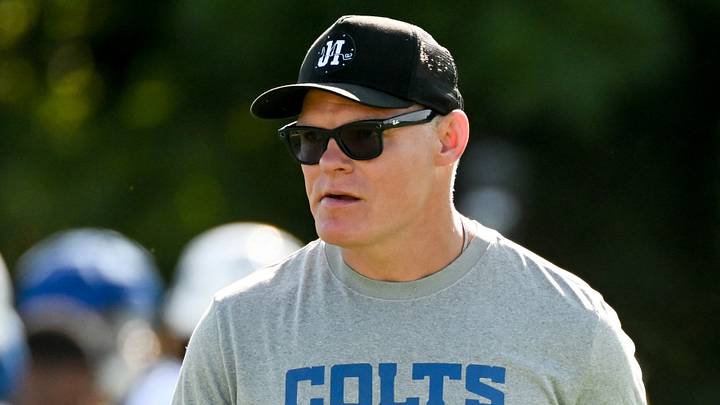
After a decade-long career as General Manager of the Indianapolis Colts, Chris Ballard was finally fired on October 19. Ballard was hired back in 2017 to help the Colts return to annual Super Bowl contention. He did not come close to meeting those expectations.
In 10 years, the Ballard-led Colts won zero division titles, made the playoffs twice, and won just one playoff game. Given the utter lack of success during his tenure, it's no surprise that Ballard’s time in Indianapolis has ended. A better question might be what took so long.
There are plenty of people responsible for the Colts’ failures, but Ballard is at the very top of the list. His frequent roster construction missteps prevented Indianapolis from ever fielding a truly competitive team. And his biggest blunders actually handicapped the Colts for years to come.
5 franchise-altering mistakes from Chris Ballard’s 10 years with the Indianapolis Colts
Mistake No. 1: The 4-year quarterback carousel
When Andrew Luck retired right before the 2019 regular season, it changed the trajectory of the franchise. Ballard isn’t at fault for Luck’s shock decision, but he is to blame for never truly replacing him.
In the aftermath of Luck’s retirement, Ballard should have immediately started looking for a long-term solution at the most important position in football. Instead, Ballard was shortsighted, leaning on a revolving door of one-year rentals.
From 2019 to 2022, the Colts had 4 different Week 1 starters: perennial backup Jacoby Brissett, 39-year-old Philip Rivers, Philadelphia castaway Carson Wentz, and 37-year-old Matt Ryan. Unsurprisingly, none of those band-aid fixes led Indianapolis to success. All Ballard accomplished was delaying the Colts’ search for a legitimate franchise QB.
Mistake No. 2: Drafting Anthony Richardson No. 4 overall
When Ballard finally decided to spend an early draft pick on a QB, he couldn’t afford to get it wrong, especially after waiting for so long. His choice was the 2023 No. 4 overall pick, Anthony Richardson.
Richardson’s elite physical traits earned him first-round potential, but his below-average fundamentals — accuracy, footwork, touch, and timing — were a well-known concern. Ballard gambled a top-5 draft pick on a high-upside but high-risk, developmental prospect.
That bet didn’t pay off. Richardson never developed into an NFL-caliber QB. His career completion rate is a historically bad 50.6%; he’s thrown more interceptions than touchdowns, and he can’t stay healthy. Ballard took a big swing by drafting Richardson, and he whiffed.
Mistake No. 3: Draft misses on defense
Ballard’s questionable draft record spanned 10 years and goes well beyond the Richardson pick. In fact, his most glaring weakness as a talent evaluator was on the other side of the ball. Ballard failed to find elite defensive players in the draft, especially at premium positions.
Despite multiple attempts, Ballard never landed a premier edge rusher or a lockdown cornerback, leaving huge holes in the roster. The result was a unit that ranked in the bottom half of the league in scoring defense in seven of the 10 seasons Ballard was in charge.
Ballard often reached for high-ceiling prospects that never realized their potential rather than more proven players who could contribute immediately. Most of his early-round picks on defense ended up being waived (JuJu Brents), traded away for pennies (Quincy Wilson), or banished from the league entirely (Ben Banogu).
Mistake No. 4: Never adapting despite having very little success
In his time as the Colts’ GM, Ballard’s biggest mistake wasn’t actually any single decision but his unwillingness to adapt when things went wrong. He came to Indianapolis with a strict philosophy: build through the draft, invest in homegrown players, and approach free agency and trades with caution.
Ballard stayed committed to the same plan for nearly his entire tenure, even when it failed year after year. As Indianapolis continued to struggle, he should have adapted by moving on from underperforming players sooner or pursuing outside help more aggressively. Instead, Ballard stubbornly stuck to his old ways, and the Colts kept losing.
Mistake No. 5: Going all-in for nothing
When Ballard finally decided to push his chips in, his timing couldn’t have been worse. A promising but brief 10-week stretch in 2025 convinced him that Indianapolis had a championship-caliber roster. Spoiler alert: he was wrong.
Ballard traded away 2 first-round picks midseason for Sauce Gardner before Indianapolis collapsed and missed the playoffs. He then doubled down in the offseason by spending over $200 million on contract extensions for Daniel Jones and Alec Pierce. After all that, the Colts are still nowhere close to being a playoff team.
In less than 12 months, Ballard torpedoed valuable Day 1 draft capital and future cap space just for Indianapolis to start the 2026 season 2-4, fire him, and hit the reset button. The Colts are now in full rebuilding mode, but will have to deal with the consequences of their former GM’s reckless actions for the foreseeable future.
 Add us as a preferred source on Google