

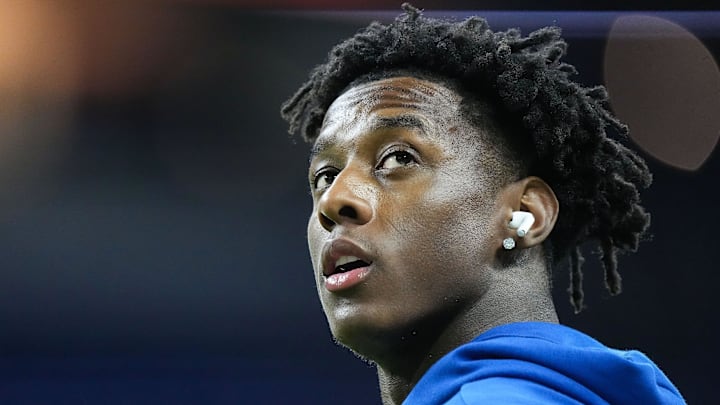
I suppose if you are not an NFL Draft geek, what ESPN.com’s Jordan Reid did the other day might seem pointless and stupid. But I’m guessing that if you’re a Colts fan and reading this, you have at least some sort of genetic predisposition toward draft geekiness, so maybe it will make sense.
What Reid did was this: before the ink was even dry on the 2026 NFL draft, he published a first-round mock draft for 2027. And he’s far from alone. I saw 2027 mocks out before the 2026 draft had even begun.
As Reid acknowledges, these exercises don’t have much validity. But they are certainly fun to debate. And sometimes, they lead you to questions that do merit a little more serious conversation.
What Indianapolis Colts fans can expect from Sauce Gardner in 2026
For instance, when reading through Reid’s mock, I was reminded of the fact that the Indianapolis Colts do not have a first-round pick next year. Chris Ballard traded it in the deal that brought Sauce Gardner to town. And that got me asking, what kind of season does Gardner need to have in 2026 to justify the trade?
You remember the trade, right? In early November, with Indianapolis sitting at 7-2 and in first place in the AFC South, Ballard swung the deal right at the trade deadline. The final seven games of the season are projected to be much more difficult, and the health of top cornerback Charvarius Ward was very much in doubt.
Ballard saw Gardner as the perfect solution for a defense that had surrendered an average of 23 points per game over the previous month to some below-average offenses. Seattle, San Francisco, and two games apiece against Houston and Jacksonville were looming. The defense had to improve.
Ballard traded two consecutive first-round picks, along with a previous second-round pick, Adonai Mitchell, for Gardner. We’ll leave Mitchell out of the analysis. In retrospect, his days as a Colt were numbered from the moment he fumbled away a surefire touchdown against the Rams in Week four.
So the question becomes – as good as Gardner is, will he be worth two first round draft picks?
A few months after the trade was made, he was already in a hole. Gardner was supposed to help the Colts into the playoffs for the first time since 2020. He got hurt and only appeared in three of a possible eight games. Quarterback Daniel Jones got hurt as well, and the Colts began a free fall. After acquiring Gardner, they lost seven of their final eight games.
That didn’t merely create immediate misery. Ballard’s initial calculations probably assumed he was giving up a pick no better than the mid-20s in the 2026 draft. It ended up being pick 16. Based on the commonly used draft pick value chart, the difference between the 16th and 26th pick in round one is the equivalent of a late second-round pick. So the cost for Gardner is greater than it initially appears.
The Jets took tight end Kenyon Sadiq with the Colts’ native pick. Indy would not have drafted a tight end in round one. They did that last year.
But they could have gotten immediate defensive line help in the form of Miami edge Akheem Mesidor or Florida tackle Caleb Banks. Or they could have filled the hole left by Michael Pittman with receivers like USC’s Makai Lemon or Texas A&M’s KC Concepcion. They could have stayed local and chosen Indiana Hoosier star receiver, Omar Cooper.
So, that’s hurdle number one for Gardner.
As we have been reminded by Reid’s mock draft, there will be another player off the board next year who could probably help the Colts.
Reid has the Jets selecting twelfth with the Indy pick. And he has them taking Oklahoma defensive tackle David Stone. That is one of three elite interior line prospects Reid identifies in that area of the draft. (Like in 2026, the Colts are projected to finish worse than hoped, making the draft pick they traded more valuable than initially thought.)
The interior of the Colts' line is aging, and they did not address the future with a couple of veteran journeymen signed this offseason. So a young tackle would be very attractive. Perhaps more alarmingly, Reid also has a couple of very promising cornerbacks – Alabama’s Zabien Brown and Mississippi State’s Kelley Jones going in the second half of round one.
So there’s another potential hurdle. Will a 26-year-old Sauce Gardner be a better long-term investment than Zabien Brown?
To be fair. None of what I have mentioned will be the main factor in judging the trade. Gardner’s 2025 season with the Colts was disappointing, but that was only a small part of why Ballard made the trade.
Gardner is signed through 2030. Were he a short-term rental, there’s no way Ballard would have paid the exorbitant price he did. Gardner is an elite talent, and he will have plenty of time to show that off with the Colts.
And comparing any player to the “what might have beens” in a given draft can get silly. There are simply too many variables involved to make definitive statements about what a GM should do.
No, Ballard, Gardner, and the trade will ultimately be judged by how well Gardner plays and how well the team performs.
Sauce Gardner was a First-Team All-Pro in his first two seasons. He appeared to fall off in his third year – 2024 – but his true performance and the reasons for it are the source of some debate. The bottom line for Colts fans is that Gardner must return to his 2022/23 level. Maybe not first-team All-Pro, but he must at least become a perennial Pro Bowler over the next several years.
What’s more, the overall defense must improve. A player of Gardner’s quality should have an impact on the entire defense. Look for the Colts’ beleaguered pass rush to improve because they are blanketing receivers. Laiatu Latu should continue to build on his sack and pressure totals. Arden Key and Michael Clemons should equal the best years of their careers.
With the perimeter locked down by Gardner – and hopefully, Ward – safeties should be able to cheat forward and help with run support. The bottom line is that the entire Colts defense should put up better numbers than it did in 2025.
As for team success, cornerbacks, no matter how gifted they are, have little direct impact on a team’s playoff chances. Hall of Famer Lem Barney played in exactly one playoff game in eleven seasons with the Lions.
Fellow Hall of Famer Aeneas Williams made just two postseason appearances in ten years with the Cardinals before ending his career with a much better Rams’ team. Suddenly, he was in the playoffs all the time.
It will be nice if the Colts end their playoff drought early in the Sauce Gardner era. If they do, no one will be complaining about the trade.
But if they don’t, all bets are off. It will not necessarily be Gardner’s fault, provided the overall defense does improve. But history will not judge Ballard kindly even if Gardner lives up to expectations, if the team does not flourish.
That is the ultimate test, and it is one that Ballard has failed far too often. Many of his individual moves – draft picks, trades – look good in isolation. But they never seem to result in a successful team. That must end for the Gardner trade to be seen as a success.
 Add us as a preferred source on Google