

The 2025 season was supposed to bring clarity for the Indianapolis Colts. And while it had it's positives, it also delivered volatility.
As much as went right for Indianapolis this fall, also went wrong. It was a franchise that once believed it had finally found a game-changer under center in Anthony Richardson, and he's been relegated to holding a clipboard. Daniel Jones, who briefly elevated the Colts into the conversation as one of the AFC’s more dangerous teams when healthy, saw his season cut short by a torn Achilles.
Desperation followed, with a 44-year-old Philip Rivers brought in to stabilize the operation and a sixth-round rookie, Riley Leonard, forced into meaningful snaps. It was chaos under center personified.
What does the future look like for the Indianapolis Colts?
Now, as the Colts turn the page toward 2026 and beyond, the most pressing questions remain under center -- but the foundation of the roster extends far beyond the position that matters most.
Offense: Built Around Proven Talent
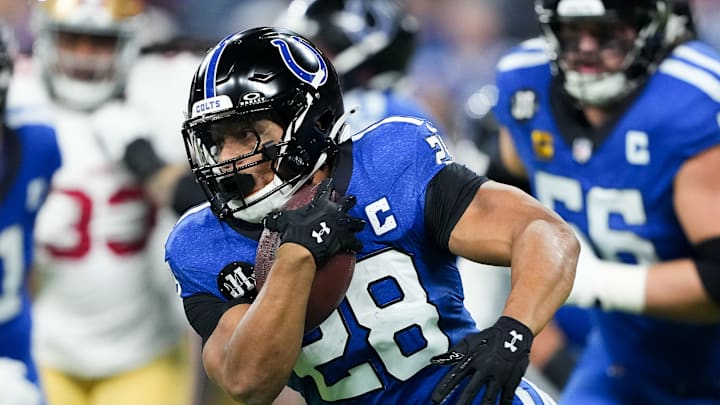
Any discussion about the Colts’ offensive core begins with Jonathan Taylor. Entering his seventh NFL season in 2026, Taylor remains one of the league’s premier offensive weapons.
His combination of vision, power, and burst continues to define the Colts’ offensive identity, and even as mileage accumulates, Taylor is still a player opposing coordinators have to build entire game plans around, and his presence alone raises the floor of the offense.
At tight end, Tyler Warren has quickly established himself as a foundational piece. The Colts’ first-round pick out of Penn State in 2025, Warren, impressed throughout a rookie season that showcased his versatility. He can function as a true inline tight end, holding up in the run game, but his ability to flex out into the slot and stress defenses in space changes how opponents align.
On the perimeter, Michael Pittman Jr. remains a core component of the passing game. His physicality, reliability at the catch point, and ability to work the intermediate areas of the field provide stability amid quarterback uncertainty.
Alec Pierce’s future, however, is less certain as he approaches free agency, but his flashes over the years -- particularly as a vertical presence -- will make him an intriguing decision point for the front office. Josh Downs, meanwhile, is a player the Colts have consistently wanted more from. Now through three seasons, the explosiveness is evident, but consistency remains the missing ingredient.
Up front, the Colts are anchored by one of the NFL’s most dominant interior linemen with Quenton Nelson, who, when healthy, is still the tone-setter and emotional backbone of the offense. Drafted in 2018, Nelson has built a résumé that already places him among the best guards the league has ever seen, and his presence alone elevates the young players around him.
At center, Tannor Bortolini has quietly developed into a reliable, high-level starter. A day-three pick out of Wisconsin, he doesn't may garner a ton of attention, but his ability to drop anchor in pass protection and work efficiently to the second level makes him a strong long-term piece -- particularly alongside Nelson.
Right guard Matt Goncalves, a third-round pick from Pitt in the same class, offers versatility and steadiness (allowed just two sacks in 2025). While not flashy, he's dependable and functional, traits that matter greatly in the interior.
On the edges, Braden Smith continues to be a stabilizing force, while Bernhard Raimann provides depth and flexibility. The offensive line, as a whole, remains one of the clearer strengths of the roster heading into the future.
Defense: Cornerstones and Questions
Defensively, the Colts’ core is less complete, but not without high-end building blocks.
On the edge, Laiatu Latu has emerged as the centerpiece. The former UCLA standout and 2024 first-round pick took a significant leap in year two, establishing himself as one of the better young pass rushers in football. His ability to win with technique, timing, and motor makes him a true foundational defender.
Kwity Paye remains a more complicated evaluation.
He brings size and physicality and is reliable on early downs, but his inconsistency as a pass rusher continues to limit his ceiling. Moving forward, Paye feels more like a replaceable piece than a long-term pillar.
JT Tuimoloau didn't make an immediate impact as a rookie, but his physical tools and pedigree suggest the Colts will continue to invest in his development as part of the defensive front rotation. He amassed 14 pressures in 130 pass rush snaps in year one.
The secondary is defined by experience. Charvarius Ward, Cam Bynum, Sauce Gardner -- acquired at the trade deadline -- and Kenny Moore give the Colts a battle-tested group on the back end. However, youth is limited.
Mekhi Blackmon, acquired via trade from Minnesota, could grow into a larger role, while Justin Walley, a third-round pick in 2025, is expected to see increased snaps moving forward. Hunter Wohler is also a youth-infused piece who provides depth, special teams pop, and developmental upside as a rotational piece.
As the Colts look beyond 2026, the roster tells a clear story. The offensive core -- headlined by Taylor, Warren, Nelson, and Pittman Jr. -- is strong enough to support winning football if stability at quarterback can be achieved. Defensively, the foundation is thinner, but Latu, alongside veterans in Gardner, DeForest Buckner, and Franklin, provides legitimate cornerstones.
Ultimately, the Colts’ future hinges on whether they can finally solve the quarterback equation. If they do, the supporting cast is already in place to matter in January, or beyond.
 Add us as a preferred source on Google